


GUARDFORCE AI
Agentic AI Is Finding Its Footing in Vertical Markets — Cross-Border Travel May Be Next
Why vertical context and traveler intent may shape the next real wave of agentic AI adoption
Three-quarters of enterprise leaders say they’re deploying agentic AI. According to Forrester’s analysts, most of them are not. In their June 2026 report, The State Of Agentic AI, 2026, what’s actually running in production is largely what they call “agentish chatbots” — systems that respond, but don’t reason. Systems that answer, but don’t act. The gap between the claim and the reality isn’t purely a technology problem. It may also be a context problem. And context, it turns out, matters enormously.
In this article:
75% of enterprises claim to be adopting agentic AI, but most are running “agentish chatbots” — not true agents (Forrester, 2026)
Agentic AI tends to deliver more value in vertical domains where context is deep, intent is specific, and outcomes are measurable
Cross-border travel is a vertical that current agentic AI investment has largely passed over — the complexity of traveler intent remains underaddressed
Much of today’s travel AI investment is focused on booking speed — intent understanding remains a largely unexplored direction
DeepVoyage Go (DVGO) is building from intent first — understanding what a traveler truly wants, then matching resources accordingly
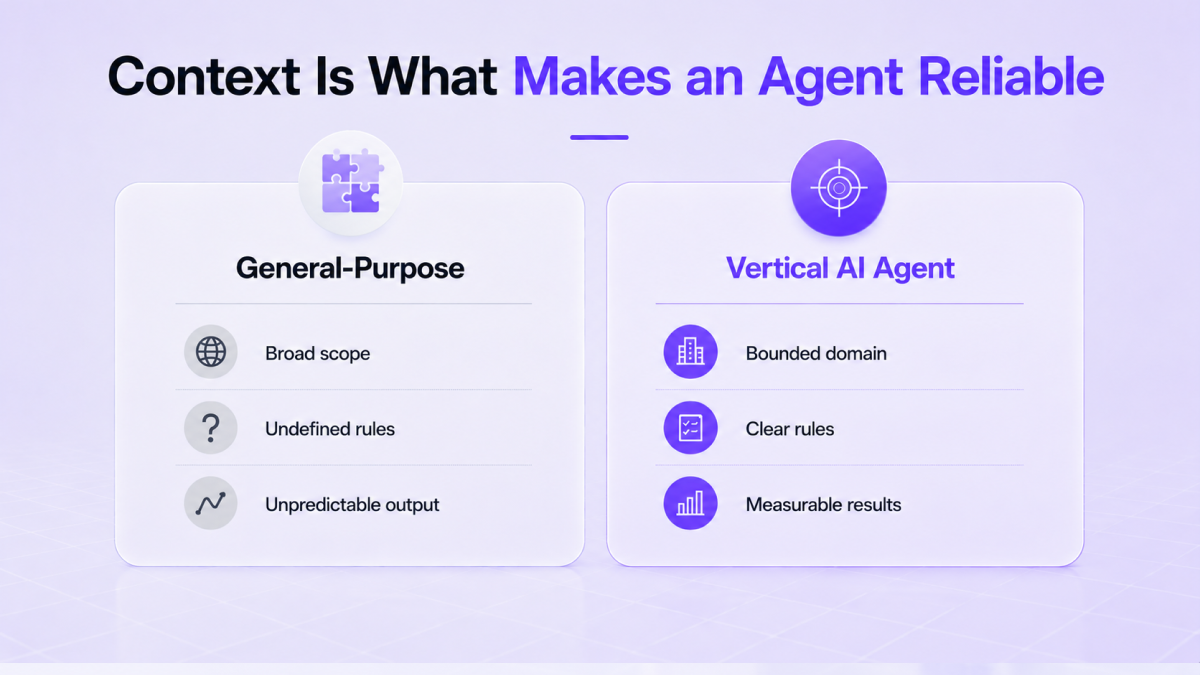
Without domain context, agentic AI struggles to deliver
Give an AI agent a goal without a domain, and it’s a little like hiring a consultant who’s never seen your industry. The advice sounds reasonable. The execution falls apart.
Gartner projects that over 40% of agentic AI projects will fail by 2027 — not necessarily because the models aren’t capable, but because the environments they’re deployed in weren’t designed for them. Legacy systems, fragmented data, undefined workflows. When an agent doesn’t know the rules of a domain, making reliable decisions within it becomes significantly harder. (Source: Deloitte Insights, Agentic AI Strategy 2026, citing Gartner)
Vertical focus gives agents the context they need to act reliably
Salesforce Agentforce — deployed within the tightly defined context of CRM workflows — reached $540 million in annual recurring revenue by early 2026. Building for a domain where inputs, outputs, and success criteria are well understood appears to create more favorable conditions for agentic AI than broad, general-purpose deployment.
This is what a16z has described as an important structural shift in enterprise AI: the move from horizontal platforms toward vertical agents that go deep rather than wide. The companies finding traction aren’t trying to do everything. They’re trying to do one thing well enough that it becomes genuinely useful.
Not all verticals are equal in complexity, though. Some — like cross-border travel — present a level of intent complexity that makes them both harder to address and potentially more valuable to get right.
Cross-border travel’s intent complexity remains largely unaddressed
IDC’s FutureScape 2026 report predicts that by 2030, 30% of all travel bookings will be executed by AI agents — and that 50% of AI budgets in hospitality and travel will be allocated to personalization efforts. The market opportunity is real. But that trajectory assumes something the industry is still working toward: agents capable of understanding why someone wants to travel, not just where.
Consider what an AI agent actually needs to understand to plan a meaningful cross-border trip. Not just destination and dates. Not just budget and airline preference. The inputs that matter most are harder to surface: Why is this person traveling? What are they trying to feel, experience, or escape? What kind of people do they want to meet? What does “the right trip” actually mean for this specific person at this specific moment in their life?
This is a level of intent complexity that most travel AI has not seriously attempted to address. While much of the industry’s attention has gone toward automating booking transactions, the question of why someone travels remains largely underaddressed.
Booking speed is a good bet. Intent understanding may be a bigger one.
Much of the current investment in travel AI is focused on transaction speed — searching inventory faster, comparing prices more efficiently, completing bookings with fewer steps. These are genuine improvements that make travel more convenient for millions of people. Intent understanding is a different starting point: not optimizing the transaction, but understanding what the traveler actually wants before the transaction begins.
DeepVoyage Go is building in this direction — cross-border travel as a demand discovery problem, not a booking problem. Starting from what a traveler wants to experience, who they want to connect with, what kind of journey fits their life right now, and then matching the right transport, experiences, and social resources to that intent. Intent first. Resources second. It’s a bet that aligns with where agentic AI appears to be finding its footing: deep in a vertical, close to the complexity of real human intent.
Data Sources
Forrester, The State Of Agentic AI, 2026: forrester.com
IDC FutureScape, Worldwide Hospitality, Dining, and Travel 2026 Predictions: idc.com
Deloitte Insights, Agentic AI Strategy 2026 (citing Gartner): deloitte.com
Salesforce Agentforce ARR, as reported across multiple financial media sources in Q1 2026
Categories: Business Insights
Tags: AI Agents, Business Insights
Share this article
Related News

Business Insights
Travel AI Won't Replace Trust, But Has to Earn It
Aug 12, 2026 · 6 min read
Business Insights
What Y Combinator Is Saying About AI-Native Services — and a Direction We Recognize
Jul 29, 2026 · 5 min read
Business Insights
China's Language Disorder Gap Is Bigger Than the Public Conversation Suggests
Jul 17, 2026 · 7 min read
Business Insights
Electronic Shelf Labels Do a Lot More Than Change Prices — Most Retailers Don't Know It Yet
Jul 7, 2026 · 6 min read